Research
The Chicago B3 Lab sits at the intersection of neuroscience, ecology, and environmental science. We use pollinating insects — primarily bumblebees and honeybees — as tractable model systems to understand how anthropogenic stressors reshape nervous systems, behavior, and ultimately ecosystem function.
Environmental Neurotoxicology
Humans have introduced thousands of synthetic chemicals into the environment, yet we know remarkably little about how these compounds affect the neural circuits that underlie animal behavior. We focus on two major classes of contaminants present at measurable levels throughout the Chicago metropolitan area:
- PFAS (per- and polyfluoroalkyl substances)
Detected in Chicago soil, water, and bee pollen, PFAS compounds are extraordinarily persistent. We are characterizing how PFOS and PFOA alter peripheral olfactory information coding in the bee antennal lobe, disrupting the sensory signals that guide foraging and navigation.
- Pesticides and herbicides
Glyphosate, 2,4-D, indazaflam, and dicamba are ubiquitous in agricultural and urban landscapes. At sublethal concentrations they impair olfactory discrimination, navigation, and associative learning — with potential consequences for colony foraging efficiency and survival.
Approaches: Electrophysiology (antennal nerve and antennal lobe recordings), voltage-sensitive dye imaging, controlled exposure studies, field residue analysis (mass spectrometry of bee pollen, bee bread, and honey).
Antennal lobe recordings · PFAS exposure · Field residue sampling
Serotonin, Cognition & Stress
Ca²⁺ imaging · Immunohistology · Computational modeling
Serotonin is one of the most ancient neuromodulators, conserved across invertebrates and vertebrates. In bees, the serotonergic system modulates olfactory processing, associative learning, and social interactions — yet baseline dynamics and stress-induced changes remain poorly characterized.
- NIH R21 — Active Project
Using Bombus impatiens micro-colonies, we are:
Characterizing baseline serotonergic modulation of the antennal lobe and mushroom body across adult life and seasonal context.
Measuring how sublethal glyphosate exposure shifts serotonergic tone and downstream sensory coding.
Building leaky integrate-and-fire computational models that predict behavioral output from circuit-level changes.
Approaches: Calcium-sensitive dye imaging of live antennal lobe tissue, anti-serotonin immunohistology, confocal microscopy, longitudinal behavioral monitoring in 10-individual queenless micro-colonies.
Conservation Technology
Answering ecological questions at scale requires technology that is accurate, affordable, and deployable by researchers and communities alike. We develop and maintain open-source hardware and software platforms for automated pollinator monitoring.
- AutoPollS (Autonomous Pollinator Sampling)
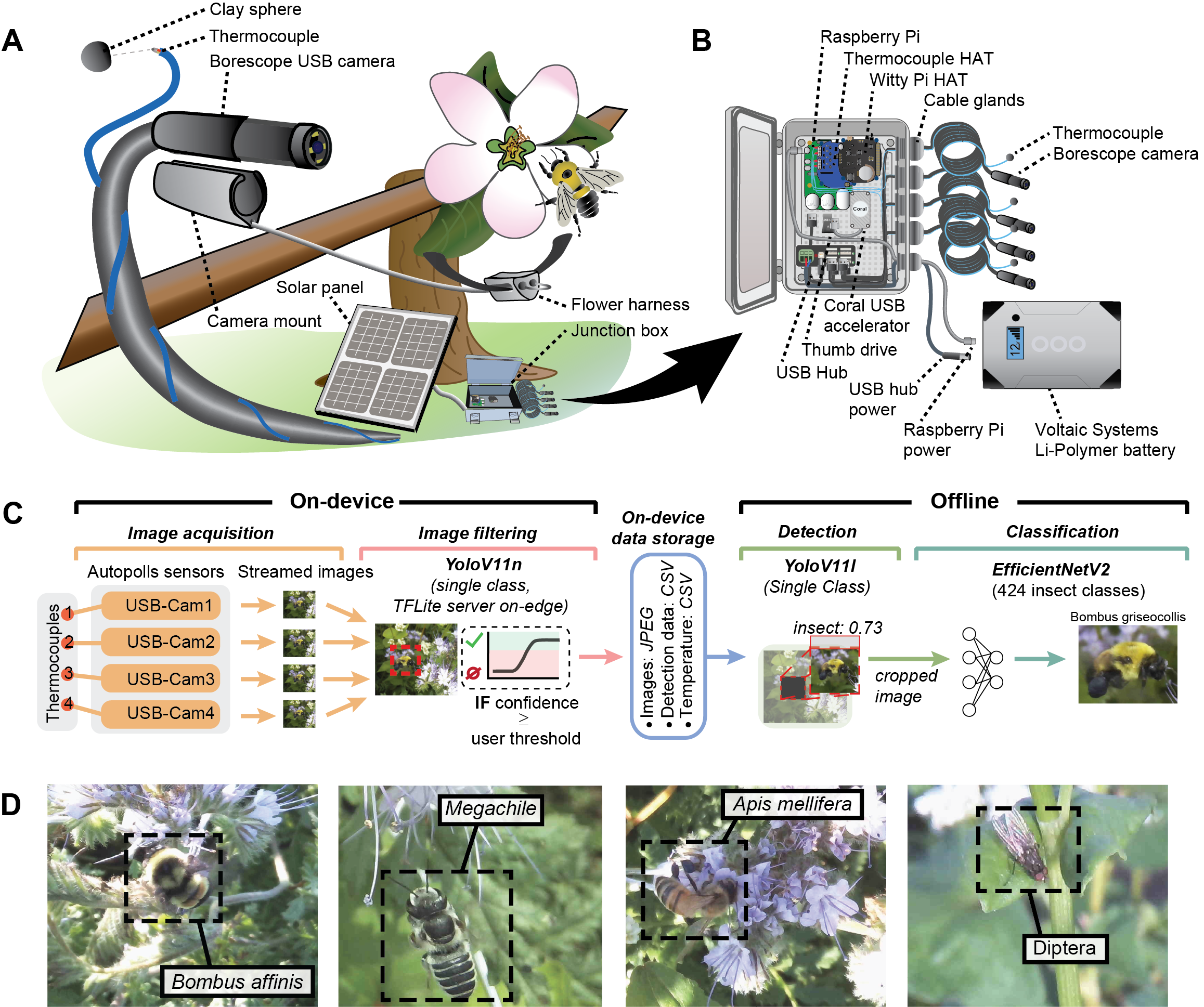
A Raspberry Pi–based camera trap system using on-device deep learning (TensorFlow Lite, YOLOv11) for real-time insect detection and classification. Deployed at IIT’s University Farm and Bronzeville urban prairie sites. All hardware designs, firmware, and models are open-source on GitHub.
- Behavioral Tracking Rigs
Custom 3D-printed and laser-cut arenas instrumented with Raspberry Pi cameras and microcontrollers for high-throughput olfactory conditioning, navigation assays, and colony-level behavioral tracking. Full designs and analysis code are freely available.
- Field Sensing
Miniaturized temperature loggers, acoustic sensors, and drone-based remote sensing complement our camera network for multi-scale environmental characterization.
AutoPollS · Edge AI · Open-source rigs
Urban Ecology & Environmental Justice
Chicago · Bronzeville · Community partnerships
Environmental contamination is not distributed equally. Industrial legacy sites in Chicago’s South Side — including the Bronzeville neighborhood’s abandoned elevated rail corridor — concentrate PFAS, lead, heavy metals, and asbestos in communities that have historically borne disproportionate environmental burdens.
We are conducting transect-based sampling of 14 sections of this corridor, correlating contaminant profiles with:
Insect species richness and diversity (AutoPollS camera traps, DNA metabarcoding)
Bird and tree community composition
Bee colony health metrics
This work is conducted in partnership with local community organizations, the State of Illinois, and IIT Landscape Architecture faculty, with the goal of informing site remediation and green infrastructure planning.
Ecological Networks & Multi-Level Selection
Plant–pollinator networks are shaped by both ecological interactions and evolutionary processes operating simultaneously at the individual, colony, and community level. In collaboration with colleagues studying microbial communities and marmot populations at the Rocky Mountain Biological Laboratory, we are developing a unified theoretical framework for multi-level selection in multi-species ecological networks.
How do plant–pollinator interaction networks arise from individual-level foraging decisions and neural variation in sensory preference?
What selection pressures operate at the network level, and how do they feed back to shape individual traits across generations?
Drones, eDNA, LIDAR, and automated cameras generate the population-scale data needed to parameterize network and selection models.
Approaches at a Glance
Category |
Methods |
|---|---|
Neurophysiology |
Extracellular electrophysiology, voltage-sensitive dye imaging, Ca²⁺ imaging, retrograde anatomical staining |
Anatomy |
Confocal microscopy, immunohistology, micro-CT scanning, mushroom body & antennal lobe mapping |
Behavior |
Olfactory conditioning, navigation assays, automated ethograms, longitudinal colony monitoring |
Field ecology |
AI camera traps (AutoPollS), drone surveys, LIDAR, acoustic monitoring, DNA metabarcoding |
Chemistry |
Mass spectrometry for PFAS, pesticide, and heavy-metal quantification in bee products and environmental samples |
Computation |
Leaky integrate-and-fire models, connectome-based circuit models, deep learning (YOLO, TensorFlow Lite), ecological network models |